



- No products in the cart.
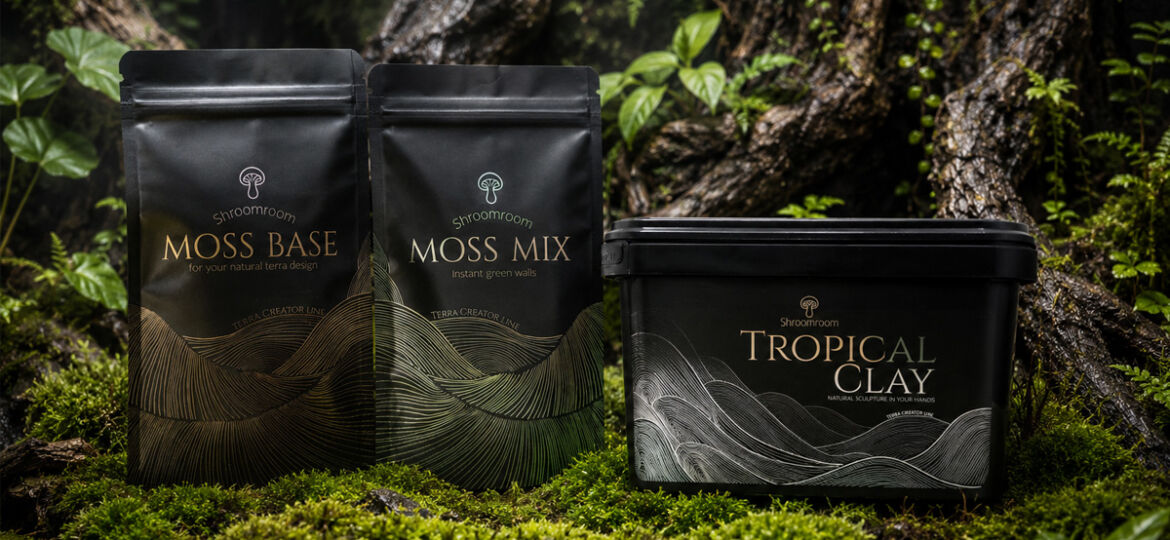
ShroomRoom terrarium: natural moss walls with MossMix, MossBase, and Tropical Clay
A ShroomRoom terrarium is not about a background that must be fully finished on day one. It is the subsequent development that makes the system interesting. Mosses establish themselves on selected areas of the background, roots become increasingly intertwined with the landscape, and harsh transitions between different materials slowly disappear beneath living growth.
This approach to terrarium construction differs from simply placing decorative material against a back wall. Using ShroomRoom MossMix, MossBase, and Tropical Clay, you first build the structure and establish the conditions that allow the final composition to take shape. This gives you far greater control over where the moss grows, which parts of the back wall remain visible, and how the roots, substrate, and vegetation ultimately blend into a unified whole.
with a ShroomRoom terrarium future moss growth is already factored into the design. The back wall is not merely a backdrop, but a surface allowed to evolve further. This process is clearly visible in the photos: from a dark, largely bare structure to an increasingly green and natural-looking whole.
Why a ShroomRoom terrarium is built differently
A convincing terrarium background rarely consists of a single, uniform material. In nature, you see variations in elevation, dark crevices, roots, damp ledges, and areas where hardly anything grows. Other zones, by contrast, are completely covered in moss and small plants. This variety gives the landscape depth.
The strength of a ShroomRoom terrarium lies precisely in that combination of structure, suitable growing zones, and living development. Instead of adding moss later on, you can plan from the very beginning where you ultimately want to see vegetation.
This creates a much more controlled result. For example, a root does not need to disappear completely beneath the greenery. Dark areas of the background can remain visible, while other zones are gradually taken over by moss. It is precisely that contrast that gives a terrarium a professional and natural look.
MossBase as the foundation of a ShroomRoom terrarium
For example, you can apply MossBase around root structures, in shallow hollows, on ledges, or on parts of a sculpture where you want to create a green transition. This allows you to determine much more precisely in advance where the moss will grow.
Why the substrate is important for moss in the terrarium
A fully moss-covered wall can be impressive, but a natural terrarium background often has more impact when not every surface is green. A combination of dark substrate, visible roots, and vegetated areas creates greater depth and contrast.
MossBase helps with this because you only need to apply it where necessary. This allows you to intentionally leave bare areas while preparing other sections for moss growth. As a result, the outcome is less uniform and much more natural.
MossMix for natural moss growth in a ShroomRoom terrarium
Once the base is prepared, the living layer comes into play. ShroomRoom MossMix is composed of various moss species and spores and was developed to create green surfaces in tropical terrariums.
MossMix does not contain sphagnum as part of the blend. Instead, the product is designed to develop a varied moss layer that mimics natural tropical terrarium walls.
The goal is not simply to cover the background with as much moss as possible. MossMix becomes particularly interesting when used as part of the composition; the moss can grow along roots, frame dark areas, and visually connect different sections of the background.
In this way, moss becomes part of the design rather than just decoration.
From a bare terrarium back wall to a living moss wall
In the initial phase, the overall look is primarily defined by the layout. The driftwood, dark background, and openings form the skeleton of the landscape. As the moss begins to develop, a second layer emerges. The greenery softens the hard elements without completely obscuring the original structure.
Later, a much more complex picture emerges. Mosses cover larger areas, small plants blend into the background, and roots no longer appear to be placed against the wall but seem to emerge from the landscape itself.
That is the difference between a decorative background and a living background.
Tropical Clay for structure in a ShroomRoom terrarium
A good terrarium background requires not only vegetation but also shape. ShroomRoom Tropical Clay is a moldable material that allows for the creation of natural structures and transitions.
You can use Tropical Clay around wood, roots, existing backgrounds, or rocky structures. It allows you to soften hard, straight edges, visually blend roots into the background, and add texture to flat areas.
This effectively turns Tropical Clay into a sculpting material within the terrarium.
Even a slight elevation or depression can make a significant difference. Light strikes a protruding edge differently than it does a dark recess. A root looks more natural when it emerges partially from a sculpted substrate than when it is simply attached to a flat background.
Combining tropical clay with moss
The real power emerges when Tropical Clay is combined with MossBase and MossMix. You can first shape the structure using Tropical Clay, then apply MossBase to selected areas, and finally allow those zones to become covered with MossMix.
This creates a transition from hard structure to living vegetation. The result feels much more like a single landscape than when all the materials remain visibly distinct.
With Tropical Clay, you can therefore model the base of a ShroomRoom terrarium before adding the living vegetation.
MossMix, MossBase, and Tropical Clay as a single system
The ShroomRoom products can be used individually, but the series becomes particularly interesting when viewed as a single system.
The hardscape of the terrarium establishes the basic layout first. Wood, roots, and other structures give direction to the design. Tropical Clay allows these forms to be further adjusted and integrated. Next, you determine where vegetation is desired and apply MossBase.
Only then comes MossMix.
This approach has a significant advantage: you don’t build a complete terrarium wall first and then try to get moss to grow on it. Instead, you consider from the very beginning what the terrarium might look like in a few months’ time.
That makes the approach much more professional and gives you more control over the final result.
How a ShroomRoom terrarium develops further
Living materials behave differently than artificial decorations. Moss growth is influenced by light, moisture, ventilation, and the properties of the substrate. As a result, each terrarium develops in a slightly different way.
That is not a disadvantage, but rather one of the reasons why natural terrariums remain interesting.
An artificial background is largely complete on day one. A living background changes. Small green patches grow larger, some areas develop faster than others, and plants eventually begin to become part of the background itself.
As a result, a ShroomRoom terrarium can take on an increasingly natural appearance over time, without the original hardscape disappearing completely.
The photos of the development process clearly illustrate this. The central root remains recognizable throughout the process but becomes increasingly integrated with its surroundings. The dark background remains partially visible as green areas expand. This creates depth, rather than a single, uniform expanse of green.
Professional terrarium results without an artificial look
A professional terrarium does not need to be overly sleek or completely overgrown. In fact, a certain degree of irregularity is what makes a natural layout convincing.
Leave dark areas visible. Let roots run through the moss. Leave small openings and avoid giving every centimeter of the back wall the same texture.
When a patch of light-colored moss lies next to a dark surface, the green appears more intense. When moss grows around a root, that root gains a sense of depth. And when some areas are more densely covered than others, it creates the impression that the landscape has developed naturally.
A well-constructed ShroomRoom terrarium therefore does not need to be fully green on day one. Above all, the design must be robust enough to become increasingly natural-looking as it develops further.
MossBase and MossMix combine for targeted moss growth.
The combination of ShroomRoom MossBase and ShroomRoom MossMix, in particular, offers a great deal of control over the final vegetation.
MossBase can be applied to selected areas of the background. You then use MossMix on those specific zones. This allows you, for example, to create a single large mossy area, form several smaller patches of green, or design a gradual transition from a dark background to a more densely vegetated section.
As a result, MossBase and MossMix give you much more control over where the vegetation develops within a ShroomRoom terrarium.
That approach also prevents the entire back wall from turning into a single, uniform green sheet. The structure of the background remains part of the design.
ShroomRoom terrarium for a living end result
The ShroomRoom Terra Creator Line is particularly interesting for terrarium builders who want to go beyond an immediately ready-made result.
Use ShroomRoom Tropical Clay to shape the background, ShroomRoom MossBase to create suitable zones for moss growth, and finally ShroomRoom MossMix to add the living element.
The photos clearly illustrate the extent of the difference between the various stages of development. The original structure does not disappear; instead, it gains character as more and more greenery develops between the dark areas and the roots.
That is ultimately what a ShroomRoom terrarium is all about: not adding as much decoration as possible, but creating the right structure so that the landscape can continue to develop.
In doing so, ShroomRoom provides you not only with materials to build a terrarium, but above all with greater control over how a living terrarium background ultimately takes shape.

Related Posts
 Biotopo