



- No products in the cart.
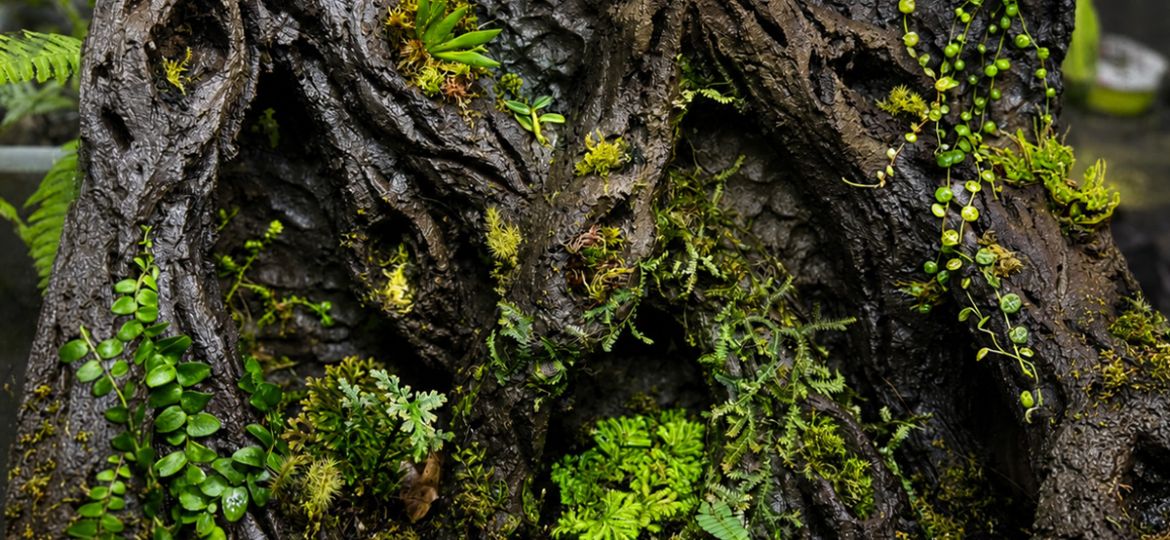
Creating a natural terrarium backdrop is one of the best ways to give a terrarium, paludarium, or vivarium more depth, atmosphere, and realism. Instead of a bare glass wall or standard backdrop, you can build your own landscape with texture, root structures, planting areas, moss, and natural details. The result feels less artificial and fits much better with a tropical theme.
Especially in poison dart frog terrariums, tropical vivariums, paludariums, and bottle forests, the back wall is much more than just decoration. The back wall sets the mood, creates a sense of depth, and determines how plants, moss, wood, and moist zones come together. A well-constructed back wall can make the difference between a simply decorated terrarium and a small slice of tropical wilderness.
With ShroomRoom products, you can build up a natural backdrop layer by layer. Use Tropical Clay for shape and texture. MossBase serves as a preparatory decorative base layer. MossMix then provides the green finish with Asian mosses and fern fronds. Together, these three products form a logical system for anyone who wants to create their own natural terrarium background.
Why Make Your Own Terrarium Backdrop?
A standard backdrop can be attractive, but it often lacks flexibility. You’re limited to a specific shape, color, and texture. By making your own terrarium back wall, you decide exactly what the layout will look like. You can create elevation changes, build hiding spots, add planting zones, and let wood or cork blend naturally into the rest of the terrarium.
A homemade back wall also adds much more depth. Especially in smaller terrariums, a flat back wall can quickly look boring. With texture, root-like shapes, and planted areas, the terrarium appears larger and more natural. The wall becomes part of the habitat rather than just a backdrop.
This is particularly interesting for tropical terrariums. Many tropical animals and plants come from environments with damp walls, tree roots, moss, leaf litter, and organic structures. By using natural materials, you can recreate that atmosphere much more effectively.
The ShroomRoom System: Shape, Base, and Green Finishing Touches
If you want to create a natural terrarium backdrop, there are really three steps involved. First, you need to create a shape. Next, you need to prepare the surface. Finally, you finish the wall with natural green details.
That’s why the combination of ShroomRoom Tropical Clay, ShroomRoom MossBase, and ShroomRoom MossMix works so well. Each product has its own specific function.
ShroomRoom Tropical Clay is the first step. This is a natural modeling clay that you can use to create backdrops, root structures, reliefs, edges, planting areas, and decorative shapes. The clay adheres well to glass and wood, does not crack in high humidity, and can be re-moistened and reshaped.
ShroomRoom MossBase is the second step. Mix this product with water until it forms a uniform mixture, then apply it as a decorative base layer. MossBase helps dry moss mixtures spread more evenly and stay in place on the surface.
ShroomRoom MossMix is the third step. This improved dry mix contains Asian mosses and fern spores. The composition has been improved with more varieties, more spores, and no dead sphagnum moss. As a result, the texture is finer, and the mix adheres better to side walls, back walls, and other vertical surfaces.
In short: Tropical Clay is for the shape, MossBase is for the base, and MossMix is for the green effect.
Step 1: Create the basic shape with Tropical Clay
A natural terrarium backdrop starts with shape. A flat wall only becomes interesting when you add depth, lines, and natural textures. With ShroomRoom Tropical Clay, you can decide for yourself what the wall will look like.
You can apply the clay to glass, wood, or any other dry decorative surface. Then, shape the material by hand or with appropriate tools. Think of root structures, rocky surfaces, small cavities, planting areas, ridges, and smooth transitions between different materials.
The advantage of Tropical Clay is that you aren’t limited to a specific shape. You can really design the terrarium to suit your own taste. Do you want a deep, dark tropical backdrop with root structures? Then you can shape the clay in a coarser, more organic way. Or do you prefer a more subtle background where moss and small plants take center stage? Then you can apply the clay in a thinner, more understated layer.
While working with the clay, you can lightly moisten the surface. This makes it easier to add details and incorporate decorative elements, such as small pieces of wood, leaves, cork, or natural accents. The clay can be moistened again later and adjusted, which is helpful when you’re working step by step.
Step 2: Apply a decorative base layer with MossBase
Once the structure is ready, you’ll want to ensure the green finish remains evenly distributed. Especially on vertical walls, a loose mix can otherwise shift or fall down more quickly. That’s why ShroomRoom MossBase is a valuable intermediate step.
MossBase is a natural decorative base coat. Mix 40 grams of powder with about 80 ml of clean water until a smooth paste forms. Apply this paste to dry decorative surfaces, such as a Tropical Clay wall, cork, wood, stone, or glass.
MossBase is not intended to be used as a fertilizer, growing medium, or adhesive. It is a decorative aid that helps distribute dry moss mixtures more evenly. This makes it particularly suitable for surfaces to which you plan to apply ShroomRoom MossMix later.
When creating a natural-looking terrarium back wall, MossBase helps create a smoother transition between the structure and the moss finish. The wall looks less bare, and the MossMix can be distributed more evenly. This results in a calmer and more natural-looking final result.
Step 3: Adding Greenery with MossMix
The greenery largely determines the look of the back wall. With ShroomRoom MossMix, you can apply a dry mix of Asian mosses and fern spores to the desired surfaces. This can be done on back walls, side walls, cork, wood, stone, clay, and other decorative elements.
The updated MossMix is an improvement over the old formula. The mix contains more varieties, more spores, and no dead sphagnum moss. This is important because sphagnum can be coarser and more fibrous. A coarse mix often doesn’t adhere as well to vertical surfaces. The new MossMix has a finer texture and is therefore better suited for side and back walls.
Apply MossMix in a thin layer. A thick layer may seem appealing, but it often results in a less natural look. A thin, even application looks more realistic and prevents the material from weighing down the surface. After applying it, gently spray the mix with clean water.
Under the right conditions, the first visible results may appear after about one month. The development depends on humidity, temperature, lighting, ventilation, the substrate, and the thickness of the applied layer. An environment with approximately 70–80% humidity and a temperature around 25°C helps preserve the natural texture beautifully.
Why the combination is more effective than individual products
You can use the products individually, but you’ll achieve the best results by viewing them as a system. Creating a natural terrarium background works best when you think in layers.
Tropical Clay alone provides shape and texture, but without a green finish, the wall remains primarily a sculpture. Using MossMix alone can work on suitable surfaces, but on smooth or vertical sections, adhesion and distribution are more difficult. MossBase alone provides a better decorative base, but does not itself create the green finish with mosses and ferns.
Together, these products complement each other. Tropical Clay gives the wall a realistic and three-dimensional look. MossBase provides a better foundation on which to spread dry moss mixes. MossMix ultimately gives the wall its green, natural character.
For customers who want to create a professional-looking terrarium wall, this combination therefore makes much more sense than using a single product. You build the wall the same way you would build a natural landscape: first the structure, then the substrate, then the vegetation.
Applications in terrariums, paludariums, and vivariums
Creating a natural terrarium backdrop is useful for many different projects. In a tropical terrarium, you can create a moist wall using roots, moss, and small plants. In a poison dart frog terrarium, you can create extra depth and hiding spots. In a paludarium, you can make the transition between water and land look more natural. In a bottle forest, you can build a forest-like background or substrate structure on a small scale.
ShroomRoom Tropical Clay is especially useful for creating texture and shapes, such as raised edges, small platforms, root structures, or natural grooves. MossBase is useful in areas where you plan to apply MossMix later. MossMix then creates the moss spores and the green effect.
You can also use these products in existing terrariums to improve certain parts of the setup. A bare side wall, an unnatural piece of cork, or a transition between wood and glass can be made to look much more natural with the right layering.
Tips for a More Natural Look
A natural look usually isn’t achieved by making everything too perfect. In nature, walls, roots, and moss growth are actually irregular. So don’t make your design too symmetrical. Make some parts higher and others lower. Leave surfaces rough, with small hollows and irregularities. It’s precisely those details that create a realistic look.
Don’t apply MossMix to the same thickness everywhere. Apply a little more in some spots and less in others. This will create a more natural pattern. Combine green areas with dark clay, wood, and leaves to create more depth.
Also, give careful thought to light and moisture. Mosses and lichens need a suitable environment. A wall that is too dry will not support their growth as well. On the other hand, a surface that is constantly soaking wet can cause the material to wash away. A consistently moist environment is usually the best starting point.
Common Mistakes When Building a Terrarium Back Wall
A common mistake is leaving the back wall too flat. Even when working with natural materials, a wall can look boring if it lacks depth. So don’t just use Tropical Clay as a thin layer—use it to create real shapes as well.
A second mistake is applying too much material at once. With MossMix, applying a thin layer is often better. A thick layer can look unnatural and doesn’t adhere as well. It’s better to use MossBase as a preparatory layer and then spread MossMix sparingly.
A third mistake is not taking the conditions into account enough. ShroomRoom MossMix needs moisture and warmth to thrive. The supplier recommends a humidity level of about 70–80% and a temperature around 25°C. Under the right conditions, the first results may become visible after about one month.
A fourth mistake is assuming that Tropical Clay is a growing medium. It is not. Plants placed against or on top of the clay do not grow in the clay as a growing medium. Tropical Clay is intended as a decorative material to add texture and shape.
Safe and Proper Use
of
ShroomRoom products are intended for decorative use in terrariums, paludariums, vivariums, and bottle forests. Do not use them as food, fertilizer, plant booster, or growing medium. Tropical Clay is not a construction adhesive, and MossBase is not a growing medium.
Store the products in a dry place at room temperature. Close the containers tightly after use. Keep the products out of the reach of children and use them only as intended.
When working with Tropical Clay, you may want to wear gloves, especially if you’ll be working with the material for an extended period of time. With MossBase, mix the powder with clean water until it forms a smooth paste. With MossMix, apply a thin layer and gently spray it with water.
What products do you need?
For a completely natural terrarium background, the combination of three products makes the most sense.
Use ShroomRoom Tropical Clay when you want to create your own shapes, walls, root structures, or planting areas. This product is the creative foundation of the project.
Use ShroomRoom MossBase when you want to create a better decorative base for dry moss mixes. This product is especially useful on vertical surfaces, rough textures, and back walls.
Use ShroomRoom MossMix for the green finish. The updated mix contains more varieties, more spores, and no dead sphagnum moss, allowing it to be distributed more evenly on side and back walls.
So if you want the best results, don’t just choose a single product—instead, build up the wall layer by layer using Tropical Clay, MossBase, and MossMix.
Why make a natural terrarium background yourself
Creating a natural terrarium backdrop gives you much more freedom than working with standard decoration. You determine the shape, depth, structure, and finish yourself. With ShroomRoom Tropical Clay, MossBase, and MossMix, you can transform a bare wall into a realistic tropical background with relief, plant patches, and a green finish. Tropical Clay forms the base structure. MossBase helps to distribute dry moss mixtures more stably. MossMix provides the natural green appearance with Asian mosses and fern spores. Together, these products form a complete system for terrariums, paludariums, vivariums, and bottle forests.
For anyone who wants to create a terrarium that doesn’t look artificial but develops into a vibrant and natural whole, this combination is an excellent choice.

 Biotopo