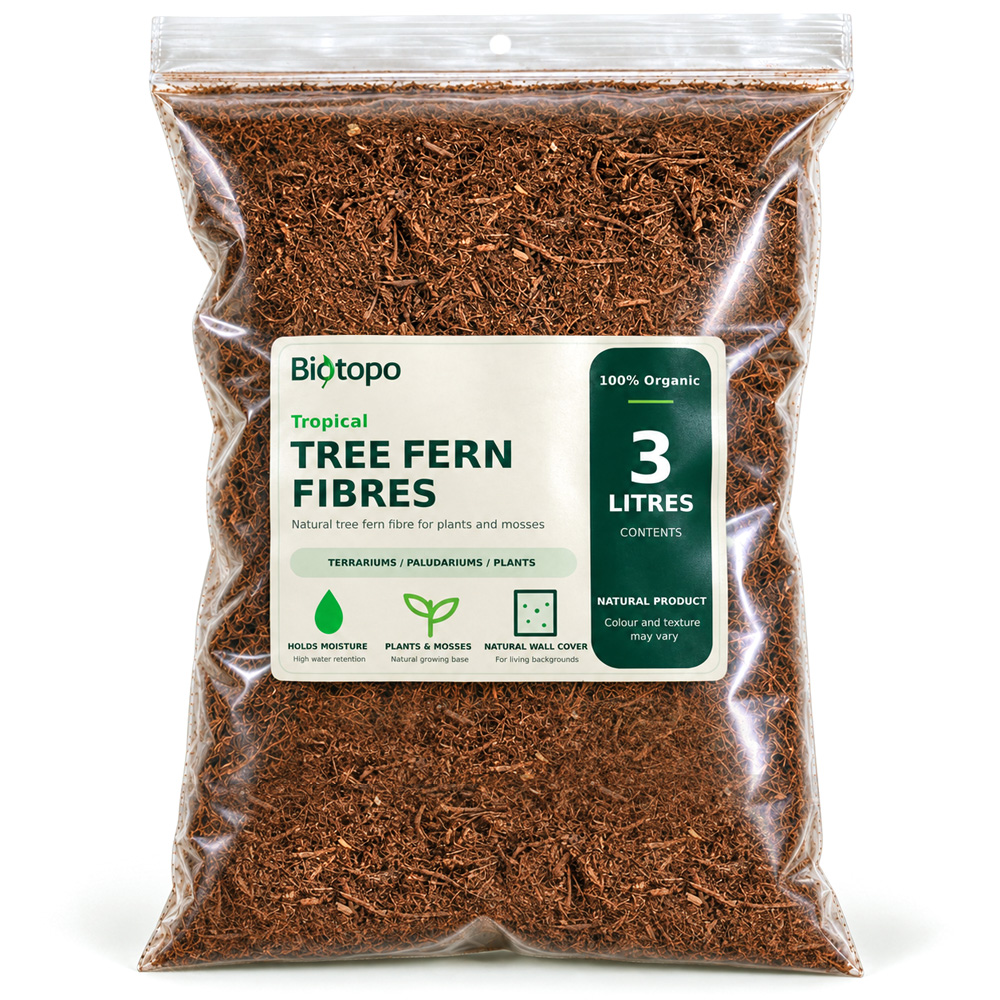

Biotopo tree fern litter for Terrariums is a natural material that gives your backdrops, planting areas, and substrate mixes an authentic rainforest look. The fern root grit consists of a natural mix of fibers, small pieces, and finer organic material derived from tree ferns. Its brown color and irregular texture complement cork, wood, moss, leaf litter, and tropical terrarium plants beautifully.
Thanks to its fiber-rich structure, the material can absorb moisture and gradually release it again. This makes fern root mulch particularly suitable for humid terrariums, paludariums, and vivariums that feature mosses, ferns, bromeliads, orchids, and other epiphytic plants. You can use it for both decorative and functional purposes: on a back wall, around plant roots, or as a light, airy addition to a homemade terrarium substrate.
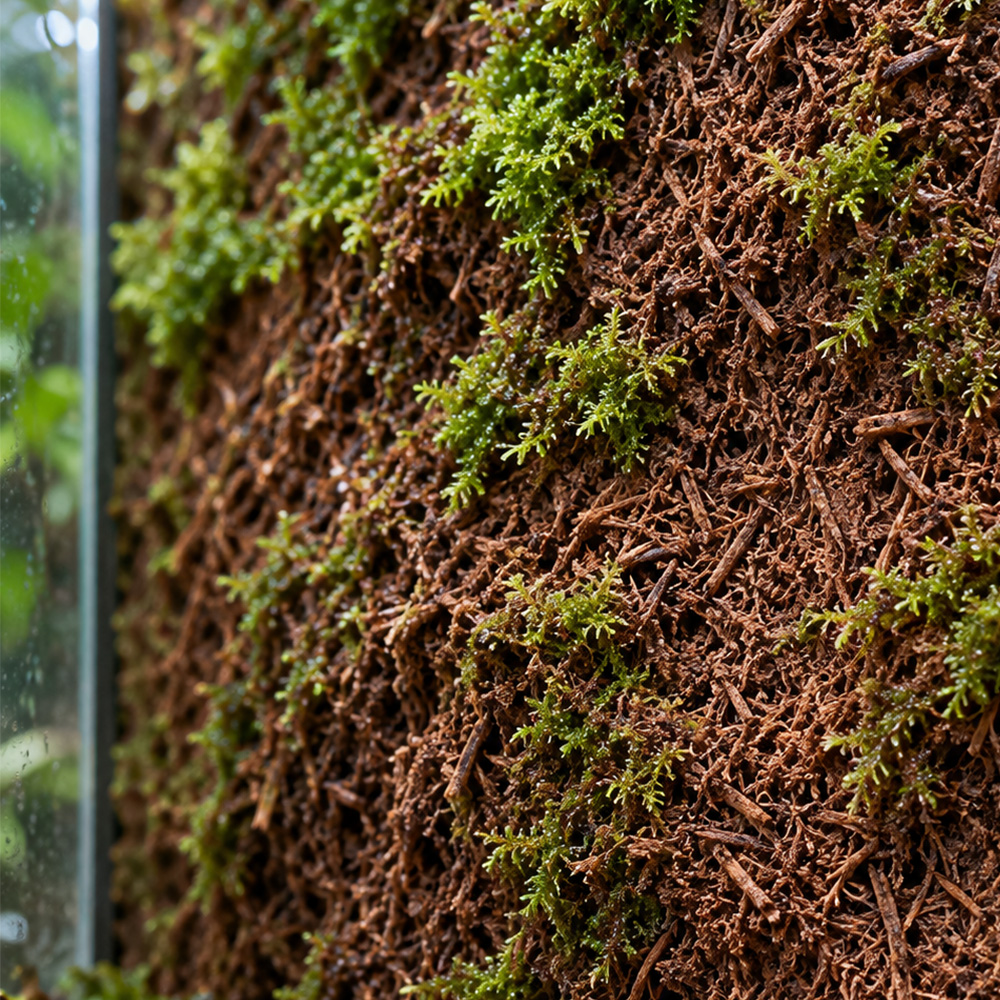
Biotopo tree fern litter for Terrariums as Natural Wall Covering
A bare terrarium back wall or visible sealant seam can disrupt the natural look of a display. By applying fern root mulch to a suitable, still-wet surface, you can create a rough and organic finish. The various fibers and particles provide more depth than a smooth layer of peat or coconut fiber.
The finished wall also provides an interesting substrate for small terrarium plants, mosses, and creeping plants. In a sufficiently moist and well-lit environment, plants can gradually spread across the surface. Any natural spores present may germinate under suitable conditions, but this cannot be guaranteed.
Use the material to completely cover the back walls, or apply it in specific areas around cork, wood, and plant compartments. It can also be used to more subtly integrate visible edges, seams, and technical components into the terrarium landscape.
Moisture-retaining substrate for moss and terrarium plants
Tree fern fibers are known for their light, porous texture. Their structure retains moisture without immediately turning into a heavy, compact mass. This creates a suitable growing medium for plants that prefer moist conditions but whose roots also need sufficient oxygen.
You can use the fern root mulch around epiphytic plants such as small bromeliads, orchids, ferns, and creeping terrarium plants. When applying moss, the coarse texture also helps keep small pieces of moss in place. Spray the surface regularly with suitable water, and adjust lighting, ventilation, and humidity to suit the chosen plant species.
This material is not a complete growing medium. For plants that require a lot of nutrients, combine it with a suitable substrate and a proper fertilization schedule. This way, you can determine the right balance between drainage, aeration, moisture retention, and nutrients.
Natural tree fern litter for tropical terrariums and paludariums
Biotopo tree fern litter for Terrariums are designed for enthusiasts who want more than just a flat, artificial background. This natural material is ideal for rainforest terrariums housing, for example, poison dart frogs, geckos, and other animals kept in a tropical-style enclosure. Always tailor the entire setup and environmental conditions to the needs of the specific species being kept.
In a paludarium, you can use tree fern litter in higher, moist areas that aren’t constantly submerged. It can also be used in planting beds, on root structures, and in the transitions between the back wall and the substrate. Combining different materials creates a landscape that looks less artificial and allows plants to grow on multiple levels.
Because this is a natural product, the color, fiber length, and the ratio of coarse to fine fibers may vary slightly from package to package. It is precisely this variation that creates a natural-looking finish.
Biotopo tree fern litter for Terrariums in Substrate Mixes
In addition to using it as wall covering, you can mix the fern root mulch into a terrarium substrate. The coarse fibers help make the mixture airier and more textured. For example, combine it with suitable bark, leaf litter, coconut products, moss, or other components that suit the terrarium and the chosen plants.
Use tree fern fibers as a supplementary component, not automatically as the sole substrate. The ideal ratio depends on humidity, watering, ventilation, and plant species. For epiphytic plants, a coarser mixture may be preferable, while a densely planted terrarium substrate often requires a broader combination of organic materials.
Leftover fern root mulch can also be used to finish small plant pots, moss sticks, wabi-kusa arrangements, and other moisture-rich plant projects.
Product Features
| Feature | Specification |
|---|---|
| Brand | Biotopo |
| Product | Fern Root Powder |
| Material | Natural tree fern material |
| Contents | 3 liters |
| Color | Natural brown |
| Texture | A mix of fibers, chunks, and finer particles |
| Application | Wall coverings, planting areas, and substrate mixtures |
| Moisture-retaining | Yes |
| Suitable for | Terraria, vivariums, and paludariums |
| Pairs well with | Moss, ferns, bromeliads, and epiphytic plants |
| Special Feature | Natural product; texture and color may vary |
Instructions for Use: Fern Root Powder
To create a terrarium background, first apply a suitable, animal-friendly sealant or other appropriate adhesive. Work in small sections so that the base doesn’t dry out before the fern root gravel is applied. Press a generous layer of gravel firmly into the wet base and make sure even the fine particles make good contact. Allow the wall to cure completely according to the instructions for the adhesive you’re using. Then carefully remove any loose residue.
Rinse or clean the finished wall if required by the fastening material used, and do not return the animals until everything has fully cured and is safe. Please note that the material is supplied loose and does not contain any adhesive.
To use it in a substrate mix, add an appropriate amount to other soil components. Moisten the mixture slightly and, after setting it up, check how quickly it dries. When using it for moss or epiphytic plants, spray the surface regularly without keeping it permanently saturated. Store unused fern root dust in a dry, cool place in a tightly sealed container.


Biotopo
Mooi spul.
Goede kwaliteit
As described 🙂
ziet er goed uit.
Goede prijs